The night market had already softened me—the lantern glow, the scooter hum, the sweet-salty air of Taipei thick against my skin. But it wasn’t until I stepped into that narrow dumpling house that the city truly focused. Inside, everything moved with intention.
Steam curled towards the ceiling. Bamboo baskets stacked high. When the basket reached my table and the lid lifted, a rush of fragrant heat rose up—ginger, broth, white pepper. The dumplings trembled in place, delicate and alive. The first bite changed everything. A careful tear, and suddenly: soup. Hot, rich, impossibly concentrated. It flooded the spoon before the tender pork followed, before the thin wrapper dissolved against my tongue. It wasn’t just something you ate—it was something you released.
In that moment, the noise of Taipei fell away. Jet lag, maps, the hustle of the street outside—all of it disappeared into one pouch of broth. The magic wasn’t just flavor. It was revelation. By the second dumpling, I wasn’t observing Taiwan anymore. I was inside it.
In Taipei, steam is a language.
Follow the steam and you’ll find soup dumplings—xiaolongbao—small, pleated parcels that carry within them not just broth and pork, but a story of migration, precision, and Taiwan’s quiet genius for refinement.
Soup dumplings did not begin here. Their origins lie across the strait, near Shanghai, where cooks once tucked rich pork aspic into dough and watched it melt into soup as it steamed. But Taiwan is where the dumpling found its final voice. After waves of mainlanders arrived in the mid-20th century, recipes traveled with them—folded into memory, adapted to new kitchens, shaped by local tastes. Over time, Taiwan did what it does best: it edited.
The Taiwanese version is lighter, cleaner, more exacting. The wrapper thins until it’s nearly translucent, elastic enough to stretch but never tear. The broth becomes clearer, less oily, designed to be sipped—not endured. Each dumpling is balanced so that no single element dominates. It’s not rustic comfort food; it’s restraint made edible.
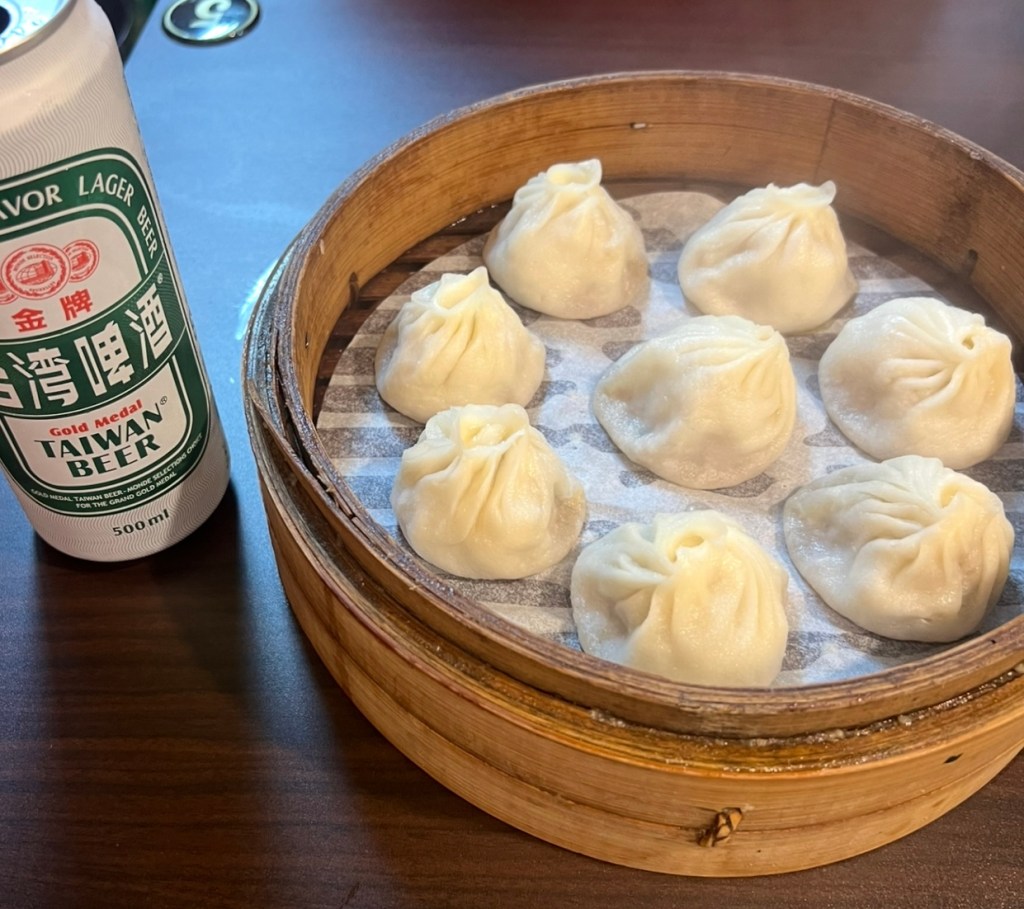
To eat soup dumplings in Taiwan is to participate in ritual. The spoon waits. Chopsticks lift gently, careful not to puncture the skin too soon. A small bite releases a shimmer of broth, which is sipped slowly, sometimes with ginger, sometimes plain. Only then is the rest eaten. This choreography is passed down casually—by parents, by servers, by watching the table next to you—but it’s followed with near-religious devotion.
What makes the dumpling extraordinary is not showiness but discipline. Apprentices spend months learning how to pleat, how to judge dough by touch, how to weigh fillings so each dumpling is identical to the next. There is pride in sameness here. Consistency is not a shortcut; it’s the point. In a culture that values mastery through repetition, the dumpling becomes a quiet manifesto.

And yet, despite the technique, soup dumplings remain accessible. They are affordable, everyday-adjacent, eaten by office workers at lunch and families on weekends. You don’t need a special occasion—just hunger and patience. This is part of their cultural power: they sit comfortably between street food and fine dining, between tradition and modernity. They belong to everyone.
In Taipei, you’ll see tourists lining up with cameras while locals slip in silently, already knowing what they’ll order. You’ll hear debates about wrapper thickness, about fold counts, about whether innovation—truffle oil, crab roe, vegetarian fillings—is welcome or heretical. You’ll notice how symmetry matters, how a slightly lopsided dumpling draws comment. Perfection is not demanded loudly here, but it is noticed.
Steam, again, rises.
It carries a recipe that crossed waters and stayed, the echo of old neighborhoods left behind, the confidence of a place that understands how to honor tradition without freezing it in time. Taiwan did not invent soup dumplings—but it perfected them by caring deeply, obsessively, and quietly.
When you leave the table, the memory that lingers is not just taste. It’s texture. Timing. The softness of the wrapper giving way, the warmth of the broth pooling in a spoon. It’s the feeling that something very small can hold an entire history—and release it, gently, in one careful bite.











 thisvanhaswings.com